

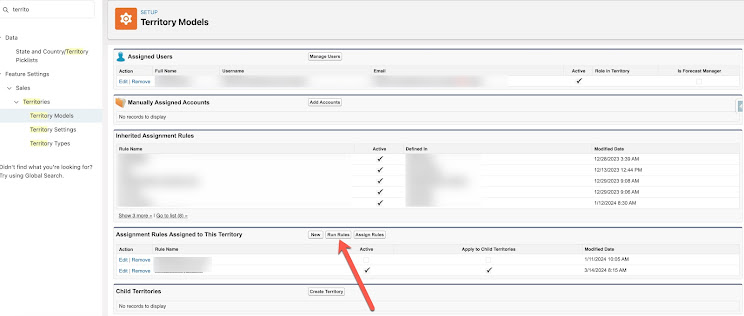
Enterprise Territory Management (ETM) rules on Account are run automatically when creation of an Account. However, they do not run automatically on account update. Out of the box, here are some options available.
Include the checkbox on the layout


- ETM rules do not run on inline edit
- DML updates from Apex do not run ETM rules
To programmatically run ETM rules on every account update, you could fire off a REST callout to update the account. This will run the ETM rules. Here is a sample code that uses Queueable job to perform this.
Make sure to pass the accountId and any other fields you would like to include in the dataWrapperJson variable.
Here's some sample code demonstrating a basic REST callout from an LWC component using Apex:
LWC component (lwcMyComponent.js):
Explanation:
We import necessary modules:
LightningElementfor the component base,apiandtrackfor reactive properties, andgetDataFromApexfrom the Apex wrapper class (replace with your actual class name).The component has two reactive properties:
datato store the response from the API anderrorto handle any errors during the callout.The
handleClickmethod is triggered on a button click or any user interaction.Inside
handleClick, we call thegetDataFromApexmethod from the Apex wrapper. This method should handle the actual REST callout logic.The call to
getDataFromApexuses.thenand.catchfor handling successful responses and errors respectively.On success, the response data is stored in the
dataproperty.In case of errors, the error object is stored in the
errorproperty for handling in the component template (e.g., displaying an error message).
Apex Wrapper Class (apexCalloutWrapper.cls):
Explanation:
This Apex class exposes an
@AuraEnabledmethodgetDataFromApexaccessible from LWC.The method defines the API endpoint URL (replace with your actual URL).
It uses the
Httpclass to create anHttpRequestobject specifying the URL and HTTP method.The
h.sendmethod sends the request and captures the response.On successful response (status code 200), the response body is parsed as JSON and returned as a Map.
In case of errors, an
AuraHandledExceptionis thrown with details for handling in LWC.
Note:
- Remember to replace the placeholder values (URL, Apex method name) with your specific API details and class name.
- Configure Remote Site Settings in Salesforce to allow access to the external API endpoint.
- This is a basic example. You might need to modify it based on your API requirements (headers, request body, etc.).